Showing posts with label information resources. Show all posts
Showing posts with label information resources. Show all posts
2012-09-21
Vélib bike-share, bike rentals and Paris Respire
It is counterintuitive that Paris, the host city of the Tour de France finish line, was ever not a bicycling capital, but until it got a bike-share program — and an expanded network of bike lanes — cycling was not a mainstream mode of transportation there. Now it’s de rigueur, thanks to the Vélib’ system’s more than 20,000 bikes at 1,800 stations. The Vélib’ app, available on iTunes, tells you where to find the nearest station and the number of bikes there. And at a little more than $2 a day, the price is hard to beat. (Bring your American Express card, though; Vélib’ machines are not compatible with Visas and MasterCards that do not have a European chip.)
For a slightly less bulky ride, the day trips at Fat Tire Bike Tours (011-33-1-56-58-10-54) come with a city cruiser. A charming, 1980s-inspired store in the 18th Arrondissement, Vélo Vintage (011-33-6-13-13-42-27) refurbishes yesteryear’s beauties plucked from the French countryside. And there is no shortage of high-end shops: the museumlike biCyCle Store Paris (011-33-9-51-61-68-29) stocks everything from California cruisers to lowriders; Cyclope (011-33-1-43-55-47-34) is for the fixie-obsessed; and Bicloune (011-33-1-42-77-58-06) is packed with bikes of all shapes.
If you have only one day to do Paris by bike, make it a Sunday, when a city program called Paris Respire (“Paris Breathes”) closes some of the loveliest areas to cars, including Montmartre, the Marais and some roads along the Seine. For spectacle, time your trip to coincide with a Béret Baguette ride, in which Parisians put a very French twist on London’s Tweed Run: bérets, Breton stripes, vintage Peugeots and a picnic of baguettes, brie and wine in the Bois de Vincennes.

2012-05-16
Antiques, Organics, and French Pate: Diving into the Markets of Paris
The Markets of Paris guidebook navigates the City of Light not through its monuments or art galleries, but by relating the history and charms of its neighborhood marketplaces.


For the updated second edition (released May 15)—which includes new photos and restaurant listings, plus sidebars on bakers, oysters, cooking classes, and more—original co-author Dixon Long collaborated with writer-photographer Marjorie R. Williams, who spent six months last year exploring 124 different food, crafts, and antiques marchés, all organized by arrondissement in the book.
You can read a short review of the book on AFAR.
2012-03-12
French Velorution
It is counterintuitive that Paris, the host city of the Tour de France finish line, was ever not a bicycling capital, but until it got a bike-share program — and an expanded network of bike lanes — cycling was not a mainstream mode of transportation there. Now it’s de rigueur, thanks to the Vélib’ system’s more than 20,000 bikes at 1,800 stations. The Vélib’ app, available on iTunes, tells you where to find the nearest station and the number of bikes there. And at a little more than $2 a day, the price is hard to beat. (Bring your American Express card, though; Vélib’ machines are not compatible with Visas and MasterCards that do not have a European chip.)
For a slightly less bulky ride, the day trips at Fat Tire Bike Tours (011-33-1-56-58-10-54) come with a city cruiser. A charming, 1980s-inspired store in the 18th Arrondissement, Vélo Vintage (011-33-6-13-13-42-27) refurbishes yesteryear’s beauties plucked from the French countryside. And there is no shortage of high-end shops: the museumlike biCyCle Store Paris (011-33-9-51-61-68-29) stocks everything from California cruisers to lowriders; Cyclope (011-33-1-43-55-47-34) is for the fixie-obsessed; and Bicloune (011-33-1-42-77-58-06) is packed with bikes of all shapes.
If you have only one day to do Paris by bike, make it a Sunday, when a city program called Paris Respire (“Paris Breathes”) closes some of the loveliest areas to cars, including Montmartre, the Marais and some roads along the Seine. For spectacle, time your trip to coincide with a Béret Baguette ride, in which Parisians put a very French twist on London’s Tweed Run: bérets, Breton stripes, vintage Peugeots and a picnic of baguettes, brie and wine in the Bois de Vincennes.
2011-05-03
Paris by Bus
After a visit to the American Library, I stand on Avenue Joseph Bouvard and wait for the 69 bus. My heart leaps as the lights illume the Eiffel Tower just in front of me. I am still in love with Paris.
That thrill continues as we slip down rue St. Dominique (it’s often a tight squeeze here) toward Invalides and Napoleon’s Tomb. We pass Place Bourgogne before I press the button to get off at St. Germain and change for a 68 or 94 or 83 which will get me home. Had I continued, I’d pass through the Louvre and by Chatelet, around the column at Bastille, out to the Pere LaChaise cemetery and Gambetta.
My favorite line is the 63, which runs from Gare de Lyon out to Port de la Muette, where the Bois de Boulogne is. We take this line, with Harika, to go for an off-leash run. On the bus she must remain in her sack. She kind of likes that, sitting in the seat with me. Blair is taking pictures out the window.
My newest project has been to create a guide to monuments and attractions on the city bus lines of Paris. The 63 passes some beauties, including Trocadero and the Tour Eiffel, the Musee Guimet, and the Statue of Liberty Flame. On the other end, the Garden of Plants and Flowers, the Arab Institute with its camera lens windows and St. Sulpice await.
But today we’re headed to Porte de la Muette, the very end, in front of the Musee Marmottan, full of wonderful Monet paintings. A statue of Fontaine, the fable-writer, graces the park, but not really visible from the bus. Day in and day out, the fox compliments the crow with the camembert in his beak.
We cross the road and Harika chases phantom rabbits as we walk across the plain to the woods. Patches of ice dot the lake we walk around; terns and gulls, coots and moor hens flit from the ice to the water. Just past the island, Harika spots a cottontail, dead, beside a crow, on the ice. Our dog jumps from the path, slipping and sliding as she hits the ice. I stop myself before going after her: this ice will never support me. Blair and I hold our breath, willing her not to fall in the frigid water; I shout, “get back here, right NOW!” She comes to her senses and arrives at our feet, dry.
We finish our walk before we head back to Avenue Henri Martin (historian and mayor) and rue Octave Feuillet (writer) to catch the 63 home. We hop out by the Deux Magots and take the 95 to our house.
My next trajet will be the route 95, which runs from Montparnasse to Montmartre, crossing the Seine and passing the Moulin Rouge. I assemble pictures and stories and will bring them to the Paris Office of Tourism.
The Impressionists were in love with Paris, too, and Van Gogh, Monet, Whistler and Grant Wood painted images of the city. In May, June, September and October, I will be leading a group of painters through Paris in a painting workshop: visiting historic views, painting them (or not) and enjoying Paris “a la impressionism” . Please join me, and suggest my tour to your friends. Even if you are not a painter, we’ll look at paintings and drink wine in cafes, which is a lot of fun.
Laurie (painting and text) and Blair Pessemier

Trees at the Bois de Boulogne LFP Acrylic on canvas 8 x 20 inches
2011-03-11
The Secret Paris Metro: ghost stations, tunnels, risks and oddities
From "Demolition of the Paris Metro" on sleepycity.net...
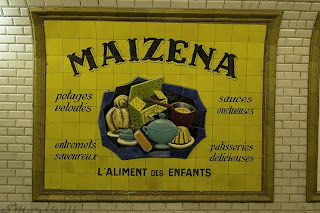
The Paris Metro and the service it provides are deeply intertwined into the fabric of the city. As the 4.5 million passengers who ride it every day will probably attest it's the quickest way around whether it's for work, for play or both. The metro's distinctive art-nouveau style is unmistakable and the plant like green wrought iron entrances topped with the orange orbs and Metropolitan signage designed by Hector Guimard which sprout up all over the city lead one down to the gleaming white tiled platforms to be whisked away around Paris. On my first trip to Paris I arrived into Gare du Nord and entered the dense maze that is the metro. Despite the crowds, the noise and the distinct odour of piss, I was in love. The kind of love which inspires one to risk life, limb and deportation to get up close and personal.
Ghost stations
Before developing a deeper appreciation of the system we were drawn to the abandoned stations. Some of these seem totally abandoned and haven't been reappropriated for other uses, some have become RATP storage and others, even more rare, were never even open to the public. With time we would conquer them all.
Raccord Tunnels
In addition to the stations … the system is full of raccords, or linking tunnels, which span between lines to enable easy movement of the rolling stock.
Attendant Risks
With time the tunnels become repetitive, the junctions similar and the abandoned stations seen. Cliché as it may be, eventually the metro becomes about the experience and the adventure, more a journey than a particular destination. The journey is a conflagration of uncontrollable variables which conspire to make it unpredictable and dangerous. But that's the fun of being within a live system and as they say, there's never a dull night in the metro.
Oddities
With the risks accepted, ghost stations done, raccords run and trains encountered one begins to develop an appreciation for the oddities in the system and begins to comb it, seeking out the weird, the undocumented and unknown places. These places will always draw back those who have a stronger interest in the metro than collecting the set of abandoned stations.
Visit http://www.sleepycity.net/posts/252/Demolition_of_the_Paris_Metro for the complete fascinating account and amazing photos.

The Paris Metro and the service it provides are deeply intertwined into the fabric of the city. As the 4.5 million passengers who ride it every day will probably attest it's the quickest way around whether it's for work, for play or both. The metro's distinctive art-nouveau style is unmistakable and the plant like green wrought iron entrances topped with the orange orbs and Metropolitan signage designed by Hector Guimard which sprout up all over the city lead one down to the gleaming white tiled platforms to be whisked away around Paris. On my first trip to Paris I arrived into Gare du Nord and entered the dense maze that is the metro. Despite the crowds, the noise and the distinct odour of piss, I was in love. The kind of love which inspires one to risk life, limb and deportation to get up close and personal.
Ghost stations
Before developing a deeper appreciation of the system we were drawn to the abandoned stations. Some of these seem totally abandoned and haven't been reappropriated for other uses, some have become RATP storage and others, even more rare, were never even open to the public. With time we would conquer them all.
Raccord Tunnels
In addition to the stations … the system is full of raccords, or linking tunnels, which span between lines to enable easy movement of the rolling stock.
Attendant Risks
With time the tunnels become repetitive, the junctions similar and the abandoned stations seen. Cliché as it may be, eventually the metro becomes about the experience and the adventure, more a journey than a particular destination. The journey is a conflagration of uncontrollable variables which conspire to make it unpredictable and dangerous. But that's the fun of being within a live system and as they say, there's never a dull night in the metro.
Oddities
With the risks accepted, ghost stations done, raccords run and trains encountered one begins to develop an appreciation for the oddities in the system and begins to comb it, seeking out the weird, the undocumented and unknown places. These places will always draw back those who have a stronger interest in the metro than collecting the set of abandoned stations.
Visit http://www.sleepycity.net/posts/252/Demolition_of_the_Paris_Metro for the complete fascinating account and amazing photos.
2005-05-19
Craigslist: the mother of all local community classifieds
Craigslist was started in early 1995 by Craig Newmark in San Francisco, California. It quickly became the leading alternative place to find a job, housing, goods & services, a social life, advice, and just about anything else. About 8 million people all over the world use craigslist each month. The Paris site started in 2004 (version française bientôt disponible). paris.craigslist.org
Franglo: free classifieds for Anglophones in France
From the Franglo website: "Franglo Classifieds is the new service for Anglophones & Anglophiles in France and around the world. Franglo Classifieds lets you read and post small ads (petites annonces) for free. There are dozens of different categories, and it's fast and easy to publish your own ads. We started Franglo Classifieds because we saw that there was a real need for a free, easy-to-use classified advertising resource for the English-speaking community in France. But Franglo Classifieds isn't just for English-speakers, and it isn't just for people living in France. Franglo Classifieds is for anyone who wants to connect with the international community in France, England, the USA, Canada, Australia, Ireland, New Zealand and elsewhere." www.franglo.com
MeetYou: community and services website for anglophones and expats
This new site has announcements, classifieds and forums. It also includes language exchange listings, an expat information center, a real estate center and a business & jobs center. You must register to gain full access to all the content. Members get to see listings of member events and meetings. www.meetyou.fr
2005-02-07
US Embassy's famous Blue Book Guide for U.S. Citizens Residing in France
The material provided in the Blue Book, Guide for U.S. Citizens Residing in France, has been compiled to provide Americans living overseas with information and assistance concerning administrative and personal matters. A veritable treasure trove of useful information.
If you don't find the information you need, you can contact the Office of American Services by e-mail at citizeninfo@state.gov. In emergency situations always call 01 43 12 22 22.
If you don't find the information you need, you can contact the Office of American Services by e-mail at citizeninfo@state.gov. In emergency situations always call 01 43 12 22 22.
Setting up a Club or Association in France
Many expats are keen to set up an association - a sports team, a cultural group, or a social club. A French law, the 'Loi de 1901', is designed to facilitate the move and provides for the advantages, not least fund-raising, of being a legal entity. Simon Coss explains how it works in this Expatica article.
Subscribe to:
Posts (Atom)